Lakeland was platted after Abraham Munn bought 80 acres in 1882 and incorporated in 1885. Its 19 National Register listings, museums and markers.
Last checked Oct. 9, 2026. Sources: the National Park Service’s National Register of Historic Places listed properties file (May 22, 2026), the City of Lakeland’s Historic Preservation and library pages, the Florida Division of Historical Resources’ historical markers and LkldNow.
Lakeland began as a land deal. In 1882, Kentucky businessman Abraham Munn bought 80 acres, site unseen, and the land was quickly platted into a small town. The town square that bears his name, Munn Park, was laid out in 1884, and the city was incorporated in 1885, LkldNow reported. The city’s historic preservation office traces Lakeland’s history to Florida’s pioneer days in the 1870s.
Who to call
- Lakeland History Room, Lakeland Public Library: 863-834-4284; librarian supervisor LuAnn Mims, 863-834-4269
- City historic preservation office: 863-834-6094, historicpreservation@lakelandgov.net
- Library address: 100 Lake Morton Drive
How Lakeland grew
- 1882: Abraham Munn buys 80 acres; the town is platted.
- 1884: Munn Park is established. That year Black residents built St. John’s Baptist Church at West Orange Street and Lincoln Avenue, east of Lake Beulah; it housed the first school for Lakeland’s Black children, LkldNow reported. Two miles east, English settlers founded Acton, a village of about 200 people that lasted until the great freeze of 1894, a state historical marker on U.S. 92 at Interlachen Parkway says.
- 1885: Lakeland is incorporated.
- 1889: Munn dedicates the Munn Park block, between Kentucky Avenue and Tennessee Avenue, south of the railroad, to remain in public ownership forever.
- 1912 and 1922: the Woman’s Club of Lakeland and the Sorosis Club are organized; their 1920s clubhouses on Lake Morton carry state historical markers.
Most of downtown’s buildings date from the Progressive Era (1890-1918) and the Florida land boom (1919-1929), the city’s recent resurvey of the Munn Park district found. Lakeland now has seven local historic districts covering 1.42 square miles, with more than 1,600 historic buildings and 13 individual landmarks; about 6% of residents live in one, the city says.
National Register of Historic Places
Lakeland has 19 listings, from the National Park Service’s May 2026 file:
| Listed | Property | Address or area |
|---|---|---|
| 1975 | Florida Southern College Architectural District (National Historic Landmark, 2012) | 111 Lake Hollingsworth Drive |
| 1983 | Lake Mirror Promenade | Between Lemon Street and Lake Mirror Drive |
| 1985 | South Lake Morton Historic District | South of Lake Morton, around Palmetto Street and Ingraham Avenue |
| 1993 | Beacon Hill-Alta Vista Residential District | Off South Florida Avenue near Beacon Road |
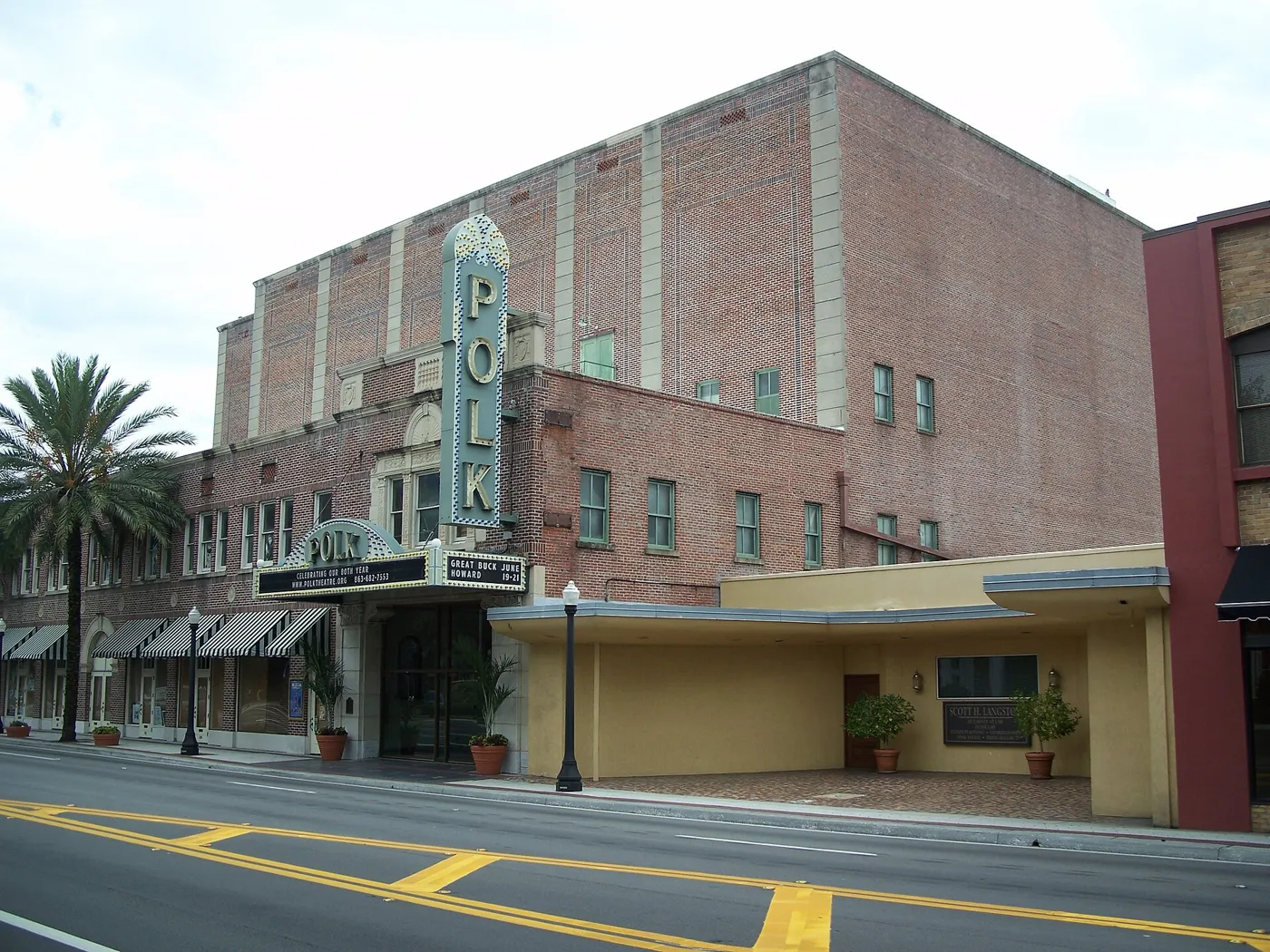
| 1993 | Polk Theatre and Office Building | 121 S. Florida Ave. |
| 1993 | East Lake Morton Residential District | Between Orange Street, Ingraham Avenue and Lake Morton Drive |
| 1993 | Old Lakeland High School | 400 N. Florida Ave. |
| 1994 | Dixieland Historic District | Between Walnut Street, Florida Avenue, Lake Hunter and Hartsell Avenue |
| 1995 | Oates Building | 230 S. Florida Ave. |
| 1997 | Henley Field Ball Park | 1125 N. Florida Ave. |
| 1997 | Munn Park Historic District | Downtown, between Bay Street, Florida Avenue, Orange Street and Main Street |
| 1999 | Central Avenue School | 604 S. Central Ave. |
| 1999 | Cleveland Court School | 328 E. Edgewood Drive |
| 1999 | John F. Cox Grammar School | 1005 N. Massachusetts Ave. |
| 2001 | Winston School | 3415 Swindell Road |
| 2002 | Lake Hunter Terrace Historic District | Around Central Avenue, Greenwood Street and Sikes Boulevard |
| 2004 | Biltmore-Cumberland Historic District | Between Ingraham Avenue, Lime Street, Bartow Road and Hollingsworth Road |
| 2007 | Griffin Grammar School | 3315 Kathleen Road |
| 2022 | Perry House | 2208 Woodbine Ave. |
Frank Lloyd Wright at Florida Southern
Florida Southern College holds what the city calls the world’s largest single-site collection of Frank Lloyd Wright-designed buildings. The campus, at 111 Lake Hollingsworth Drive, was listed on the National Register in 1975 and named a National Historic Landmark in 2012. The college runs a Frank Lloyd Wright Visitors Center and tours; see its visit page. Its Wright-designed Miller Planetarium reopened to the public on Sept. 26, 2026.
Museums open to visitors
| Museum | Address | Hours as published |
|---|---|---|
| Ashley Gibson Barnett Museum of Art | 800 E. Palmetto St. | 10 a.m. to 5 p.m. Tuesday, Wednesday, Friday and Saturday; 10 a.m. to 8 p.m. Thursday; 1 to 5 p.m. Sunday (closed Sundays June to Labor Day); closed Mondays. Free. |
| Lakeland History & Culture Center, at the Lakeland Public Library | 100 Lake Morton Drive | 9 a.m. to 7 p.m. Monday to Thursday; 9 a.m. to 5 p.m. Friday and Saturday; 1:30 to 5 p.m. Sunday. Free exhibit on Lakeland’s citrus history. |
| Florida Air Museum | 4075 James C. Ray Drive, at Lakeland Linder International Airport | 10 a.m. to 4 p.m. Monday to Saturday; noon to 4 p.m. Sunday; closed in August. 863-644-2431. |
Historical markers and cemeteries
- State historical markers in Lakeland include Acton (U.S. 92 at Interlachen Parkway), the Sorosis Club Building (90 Lake Morton Drive), the Woman’s Club of Lakeland and the Frank Lloyd Wright Campus of Florida Southern College. Full texts are on the state’s marker site.
- City cemeteries, open daily dawn to dusk: Oak Hill Burial Park, 4620 U.S. 98 South (office 7:30 a.m. to 4 p.m. weekdays, 863-834-3287), and Tiger Flowers Cemetery, 1140 E. Parker St. The city offers an online burial search.
What this means for you
- Start downtown: Munn Park, the Polk Theatre and the Lake Mirror Promenade are a short walk apart.
- Researching your house or family? The Lakeland History Room helps with property records and genealogy.
- Changing a building in a historic district? See building permits and zoning.
Related: parks and trails, population and growth and things to do this month.
Frequently asked questions
When was Lakeland, Florida founded?
Kentucky businessman Abraham Munn bought 80 acres, site unseen, in 1882, and the land was platted into a small town. Munn Park dates to 1884, and the city was incorporated in 1885.
How many National Register of Historic Places listings does Lakeland have?
Nineteen, from the Florida Southern College Architectural District (listed 1975) to the Perry House (listed 2022), in the National Park Service’s May 2026 file.
Where can I see Frank Lloyd Wright buildings in Lakeland?
At Florida Southern College, 111 Lake Hollingsworth Drive, which the city calls the world’s largest single-site collection of Wright-designed buildings. The campus district is a National Historic Landmark.
Is the Lakeland art museum free?
Yes. Admission to the Ashley Gibson Barnett Museum of Art, 800 E. Palmetto St., is always free, the museum says.
Where can I research Lakeland history?
The Lakeland History Room at the Lakeland Public Library, 100 Lake Morton Drive, helps with local history, property records and genealogy. Service desk: 863-834-4284.
Have your say